Treppenwitz
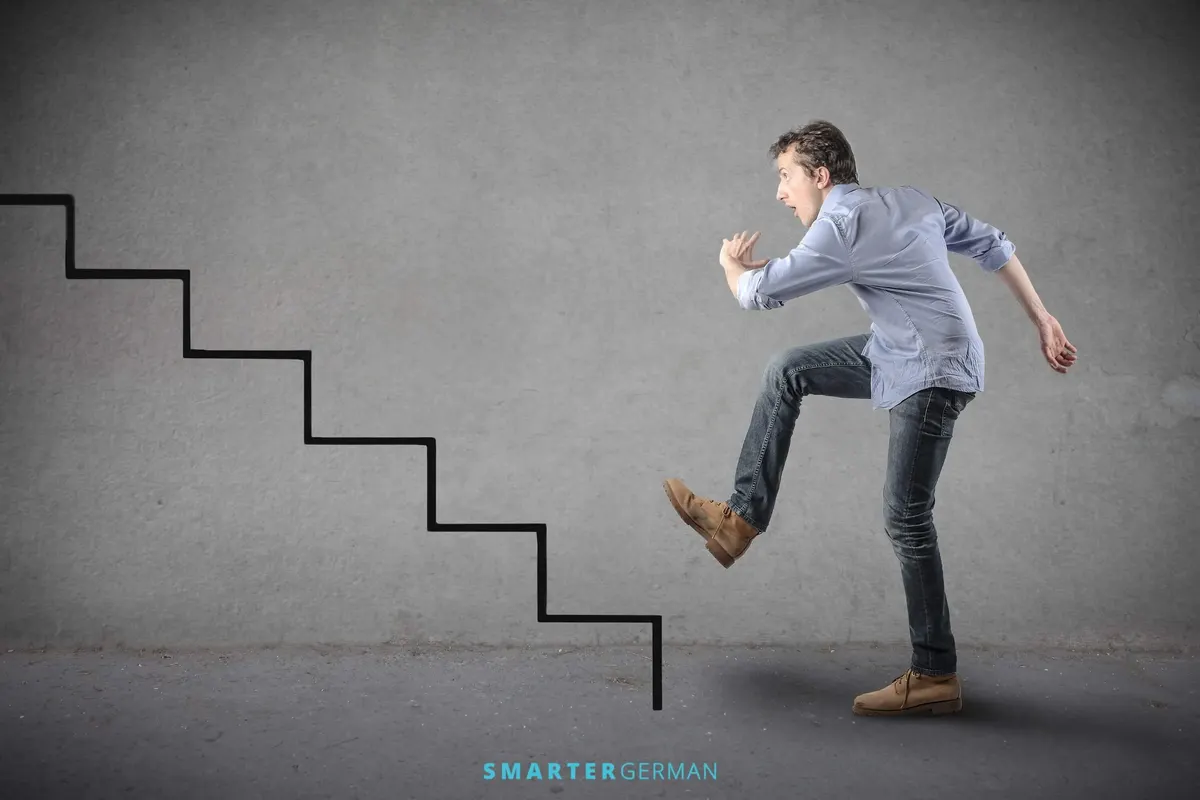
You leave a conversation and three minutes later, the perfect response hits you. Sharp, devastating, too late. You're on the staircase. Germans have a word for that.
You leave a conversation and three minutes later, the perfect response hits you. Sharp, devastating, too late. You're on the staircase. Germans have a word for that.
What does Treppenwitz mean?
Treppenwitz. Treppe = staircase, Witz = joke. The perfect witty response that arrives three minutes after you needed it - when you're already heading down the stairs and out the door.
Here's what makes it frustrating. You weren't clueless. You had the knowledge, the vocabulary, the ammunition. Your brain just needed a few more minutes to assemble it. And by then? Gone. The moment's dead. You can't go back and deliver a punchline retroactively. That's not how conversations work.
I've taught German in Berlin for over 25 years, and I can tell you: this happens to my students constantly. Not just with witty comebacks. With basic sentences. You know the word. You practiced it yesterday. But standing in a bakery with three people behind you in line, your brain goes blank. Twenty minutes later, walking home, it shows up. Brezeln. That's all you needed to say. Too late now.
English doesn't have a single word for this. You'd have to say "that thing where you think of the perfect response too late." Germans say Treppenwitz and everyone nods.
Where does the word come from?
Blame Denis Diderot. The French philosopher went to dinner parties in the 1770s, got into arguments, froze, and only thought of the right thing to say while walking down the host's staircase afterward. He called it l'esprit de l'escalier - the wit of the staircase. That's honestly a great name for it.
Germans borrowed the concept in the 19th century and turned it into Treppenwitz. Then in 1882, a journalist named W. Lewis Hertslet published a book called Der Treppenwitz der Weltgeschichte - "The Staircase Joke of World History." And that gave the word its second, broader meaning. More on that in a moment.
| Detail | Info |
|---|---|
| Literal meaning | Staircase joke |
| Origin | French: l'esprit de l'escalier (Diderot, 1770s) |
| German since | 19th century, popularized 1882 by Hertslet |
| Article | der Treppenwitz (masculine) |
| Plural | die Treppenwitze |
What's the Treppenwitz der Geschichte?
This is the meaning most people outside Germany don't know about. And it's arguably the more interesting one.
Treppenwitz der Geschichte means an ironic twist of history - when something produces the exact opposite of what was intended. History's own staircase joke.
The Berlin Wall. Built to keep people in. Became the single most powerful symbol of freedom when it fell. That's a Treppenwitz der Geschichte.
Or the Nobel Peace Prize. Named after Alfred Nobel, the guy who invented dynamite. There's a dark irony there that never quite goes away, no matter how many worthy recipients accept the award.
You'll run into this phrase in German newspapers, especially in the Feuilleton sections of Die Zeit or the Frankfurter Allgemeine. If you can use it correctly in a conversation with educated Germans, you'll get a look of genuine surprise. In a good way.
How do you actually use it?
The everyday version - that comeback you missed:
Das war ein klassischer Treppenwitz - mir ist die perfekte Antwort erst auf dem Heimweg eingefallen.
(Classic staircase joke - the perfect answer only hit me on the way home.)
Ich hasse Treppenwitze. Immer fallt mir zu spat ein, was ich hatte sagen sollen.
(I hate staircase jokes. I always think of what I should have said too late.)
And the historical irony version:
Es ist ein Treppenwitz der Geschichte, dass ausgerechnet die Mauer zum Symbol der Freiheit wurde.
(It's an irony of history that the Wall of all things became a symbol of freedom.)
Quick note: don't use Treppenwitz to mean any joke. It's not a synonym for Witz. If you call a regular joke a Treppenwitz, native speakers will look confused. It specifically means one of two things: a delayed comeback, or historical irony. Nothing else.
What do German learners get wrong about it?
Three things, consistently.
First, the meaning confusion I just mentioned. It's not "joke." It's "the joke your brain played on you by being three minutes late."
Second, pronunciation. The stress goes on the first syllable: TREP-pen-vits. Not trep-PEN-vits. German compound words stress the first element. Always. This is one of those rules that has almost no exceptions, and getting it wrong immediately marks you as a foreigner. Not a disaster, but avoidable.
Third, register. Some students treat it as a fancy word. It isn't. Treppenwitz in the "belated comeback" sense is completely casual. Use it with friends, at work, wherever. The Treppenwitz der Geschichte version is more literary, yes. But the everyday one? Totally normal dinner table conversation.
Why does German have so many of these untranslatable words?
Because German lets you glue words together. That's the real superpower. English needs a whole phrase where German just stacks components.
Treppenwitz is part of a whole family of words like this. Here are a few more you'll encounter:
| German | What it literally means | What it actually means |
|---|---|---|
| Schadenfreude | Damage-joy | Pleasure from someone else's misfortune. You know this one. |
| Fernweh | Far-pain | Longing for places you've never been. Opposite of homesickness. |
| Torschlusspanik | Gate-closing panic | That feeling that time's running out. Especially hits around 30. |
| Fremdschamen | Foreign-shame | Being embarrassed for someone who isn't embarrassed for themselves. |
| Verschlimmbesserung | Worse-bettering | An "improvement" that makes things worse. Happens a lot in software. |
| Ohrwurm | Ear-worm | A song stuck in your head. English actually borrowed this one. |
| Weltschmerz | World-pain | Deep sadness about how the world is. Not depression - more philosophical. |
Learning words like these doesn't just grow your vocabulary. It lets you think in concepts that Germans take for granted but English speakers need a full sentence to express. That's not a small thing.
Frequently Asked Questions
What does Treppenwitz mean in English?
"Staircase joke" or "staircase wit." It's that moment when the perfect response comes to you too late - you're already out the door and on the stairs. English doesn't have a single word for it. The French say l'esprit de l'escalier. Germans just say Treppenwitz.
What's the Treppenwitz der Geschichte?
An ironic twist of history where events produce the opposite of what was intended. The Berlin Wall becoming a freedom symbol. The Peace Prize bearing a dynamite inventor's name. You'll find this phrase in German essays and journalism. It marks you as someone who reads German at an advanced level.
Is Treppenwitz the same as l'esprit de l'escalier?
In the "belated comeback" sense, yes. But Treppenwitz also carries the "historical irony" meaning that the French phrase doesn't have. And it's more commonly used in everyday conversation than the French version is in France.
How do you pronounce Treppenwitz?
TREP-pen-vits. Stress on the first syllable. The "w" sounds like English "v." The "tz" at the end sounds like "ts" in "cats." First-syllable stress is the norm for German compounds - mess this up and it sounds off immediately.
What's the article?
Der Treppenwitz. Masculine. Plural: die Treppenwitze. Dative: dem Treppenwitz. Accusative: den Treppenwitz.