Quick Overview Political System Germany
Politics influence everything, so it is always good to be informed. But in order to know what you are talking about, you need to have the necessary information about the system you are living in. So...
Politics influence everything, so it is always good to be informed. But in order to know what you are talking about, you need to have the necessary information about the system you are living in. So let's try to make a quick overview of the political system of the Federal Republic of Germany.
Who runs Germany - the president or the chancellor?
If you have your origin in the United States or France, you would think that the president is the most powerful person in the state - but not in Germany. In fact, the Federal Republic just has a president in a representative manner.
The federal chancellor is responsible for overseeing the government and managing daily political affairs, while the federal president primarily holds a ceremonial role. Through their actions and public presence, the federal president symbolizes the state, its legitimacy, and unity.
The reason for this is simple: Germany has had some dreadful experiences with one person having the power of the whole state. That's why all of German politics aim at preventing one person from gaining too much influence.
What is the Bundestag?
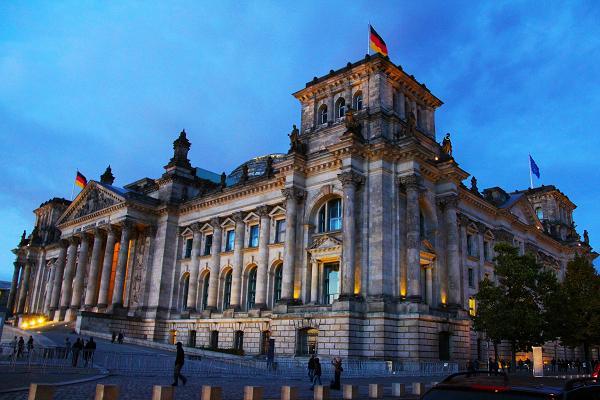
Germany is not only a federal but also a parliamentary republic. The Bundestag (literally "Federal Diet" - not to be confused with the Reichstag, which is just the name of the building) is the parliament. Its 630 members vote on and pass bills.
The Bundesrat is the second chamber, representing the federal states. Its agreement is frequently essential in the legislative process. When the two chambers disagree, the Vermittlungsausschuss (Mediation Committee) - composed of 16 members from each chamber - works out a compromise.
The Federal Constitutional Court, located in Karlsruhe, reviews whether laws and government actions comply with the Grundgesetz (Basic Law). With around 5,000 cases per year, it handles far more than the U.S. Supreme Court.
How does the chancellor get elected?
The Bundeskanzler is elected by the members of parliament, not directly by citizens. The chancellor is part of the parliament and has a mandate. So the executive and legislative branches are mixed to a certain amount, but that's not a problem: the Bundestag controls the Bundeskanzler, although he or she sets the basic principles of German policy in advance (the so-called Kanzlerdemokratie).
The parliament can dismiss the chancellor in two ways: the konstruktives Misstrauensvotum (constructive vote of no confidence) and the Vertrauensfrage (where the chancellor asks parliament for loyalty). The first has happened twice, the second five times.
Because Germany has a multi-party system, the chancellor needs to follow the election results when naming ministers. A coalition between two or more parties is normally required to form a functioning government with a parliamentary majority.
How many states does Germany have?
Sixteen. They're called Länder (singular: Land). Berlin, Hamburg, and Bremen (with its exclave Bremerhaven) are Stadtstaaten (city-states). The other thirteen are Flächenländer (area states). Bavaria, Saxony, and Thuringia call themselves Freistaaten (free states).
| Institution | Role | Members |
|---|---|---|
| Bundestag | Parliament (legislative) | 630 elected members |
| Bundesrat | Federal council (states' representation) | 69 state delegates |
| Bundeskanzler | Head of government (executive) | Elected by Bundestag |
| Bundespräsident | Head of state (ceremonial) | Elected by Federal Convention |
| Federal Constitutional Court | Constitutional review (judicial) | 16 judges, Karlsruhe |
What are the main political parties in Germany?
Christian Democratic Union (CDU)/Christian Social Union (CSU): The CDU, founded in 1950, emerged as a unifying force for Germany's Christian conservative voters in the post-World War II era. The party played a pivotal role in Germany's postwar stability, notably under Chancellor Konrad Adenauer and later Helmut Kohl, who oversaw German reunification in 1990.
Chancellor Angela Merkel (2005-2021) positioned the CDU towards the center-left. The CDU/CSU emphasizes reducing corporate taxes and benefiting high-income earners. On migration, they uphold the right to asylum but advocate for tighter restrictions and the deportation of refugees involved in criminal offenses. This party envisions Germany as a leading player in world affairs, emphasizing traditional partnerships with Europe and the United States.
Social Democratic Party (SPD): Founded in 1875, the SPD is Germany's oldest political party and traditionally represents the working classes and trade unions. Notable figures like Willy Brandt and Helmut Schmidt have left a lasting impact on German politics.
The SPD's core issues include social policy, such as a minimum wage, and progressive taxation, aiming to tax the rich while easing the burden on low and medium-earners. The SPD faced internal division over the Agenda 2010 labor market reforms, which introduced welfare cuts known as Hartz IV.
Green Party (Bündnis 90/Die Grünen): The Greens, established as an environmentalist party, draw support from well-educated, urban demographics, particularly in major cities in western Germany. Over the years, they have gained more affluent voters, with recent support from young voters concerned about climate change. The party has been divided between "realists" willing to compromise for government influence and "fundamentalists" with more left-wing perspectives.
Free Democratic Party (FDP): Founded in 1948, the FDP is a neo-liberal, pro-free market party that traditionally garners support from the self-employed, including business owners and professionals. With a focus on individual freedom, civil rights, and tax cuts, the FDP advocates for combating climate change through new technologies. They oppose expropriations, rent control, and rent caps, favoring an increase in owner-occupied homes. The FDP promotes privatization, rejects a speed limit on the Autobahn, and believes in technology's capacity to mitigate climate change's adverse effects.
Alternative for Germany (AfD): Right-wing populist, founded in 2013.
Die Linke (The Left): Successor to East Germany's ruling party. Social justice, anti-NATO.
One could write pages and pages more about the rather complicated system, but this overview should give you a first impression. For more, check the Bundeszentrale für politische Bildung (Federal Agency for Civic Education).
If you'd like to know more about German culture, check out my German courses.
Frequently Asked Questions
What type of government does Germany have?
Federal parliamentary republic. The power gets shared between the national government and the 16 states. The chancellor runs things day to day, the president is mostly there for ceremony, and the Bundestag is where the laws get made.
Is the German president powerful?
Not really. The president signs laws and represents Germany abroad, but the actual power sits with the chancellor and the Bundestag. Germans set it up that way on purpose after WWII - they'd had enough of one person calling all the shots.
How many political parties are in Germany?
There are six major ones: CDU/CSU, SPD, the Greens, FDP, AfD, and Die Linke. Because no single party ever wins an outright majority, you always end up with coalitions.