Pinakothek Museum Munich
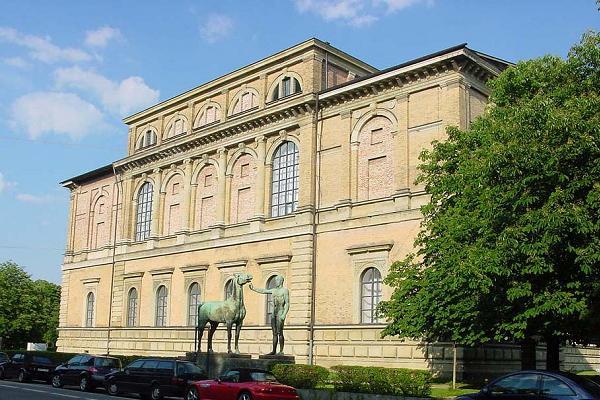
Munich has a wealth of superb museums, of which three stand out as spectacular jewels. The three Pinakothek museums are linked by their roots, mingled with the Wittelsbach family collection and...
Munich has a wealth of superb museums, of which three stand out as spectacular jewels. The three Pinakothek museums are linked by their roots, mingled with the Wittelsbach family collection and especially with King Ludwig I of Bavaria (1786-1868). While the three museums restrict their collections to specific periods, there's some overlap - take the time frames as rough guides rather than hard boundaries.
What is the Alte Pinakothek?
The Alte Pinakothek is one of the foremost European repositories of old masters - painters whose careers peaked before the 18th century, plus 18th-century painters rooted in earlier styles like Tiepolo, Boucher, and Chardin. Thousands of paintings from the 13th through 18th centuries, displayed in a rotating schedule.
German artists are well represented, but there are significant examples of Dutch, Flemish, Italian, French, and Spanish paintings. If you're pressed for time, your short list should include Rubens's Last Judgment, one of the largest canvas paintings in the world.
What is the Neue Pinakothek?
The Neue Pinakothek focuses on 18th and 19th century paintings and sculptures - more than 3,000 altogether, with at least 450 on regular display. Initially focused on Romanticism and the Munich School (naturalistic style, dark chiaroscuro, landscape and portrait subjects), the collection expanded after receiving the Tschudi Contribution with Impressionist and post-Impressionist works.
Artists include Goya, Gainsborough, Cezanne, van Gogh, Klimt, Munch, Rodin, and Picasso.
What is the Pinakothek der Moderne?
The Pinakothek der Moderne - locally known as Dritte (the third) - specialises in 20th and 21st century art across four sub-museums:
Collection of Modern Art: Classical modern through post-war to contemporary - Expressionism, Cubism, Bauhaus, Surrealism, Pop Art, Minimal Art. Artists include Matisse, Klee, Braque, Magritte, Kandinsky, Warhol, and de Kooning.
Graphical Collection: Drawings and prints from the 15th century to today, including works by Durer, Rembrandt, Michelangelo, Leonardo da Vinci, Cezanne, and Hockney. To call this a mere "graphical" collection is like calling the Andromeda Galaxy a "bunch of sparkly lights."
Architectural Collection: Probably the most extensive collection of historical and current architectural drawings in Germany, with works by Le Corbusier and Balthasar Neumann, plus contemporary computer animations and models.
New Collection (Design Museum): More than 70,000 pieces of industrial design, graphic design, and applied arts - from furniture and jewellery to motor vehicles. Designs ranging from potato peelers to skyscrapers.
| Museum | Period | Address | Phone |
|---|---|---|---|
| Alte Pinakothek | 13th-18th century | Barer Str. 27, 80333 Munchen | +49 89 23805-216 |
| Neue Pinakothek | 18th-19th century | Barer Str. 29, 80799 Munchen | +49 89 23805-195 |
| Pinakothek der Moderne | 20th-21st century | Barer Str. 40, 80333 Munchen | +49 89 23805-360 |
Frequently Asked Questions
What is the Alte Pinakothek famous for?
Old master paintings from the 13th through 18th centuries, including one of the largest canvas paintings in the world: Rubens's Last Judgment. The collection spans German, Dutch, Flemish, Italian, French, and Spanish works.
Where are the Pinakothek museums in Munich?
All three are on or near Barer Strasse in Munich's museum quarter (Kunstareal). They share a common website and are within walking distance of each other.
What is the difference between the three Pinakothek museums?
The Alte covers pre-18th century, the Neue covers 18th-19th century, and the Moderne covers 20th-21st century. The Moderne also includes architecture, design, and graphic arts collections.