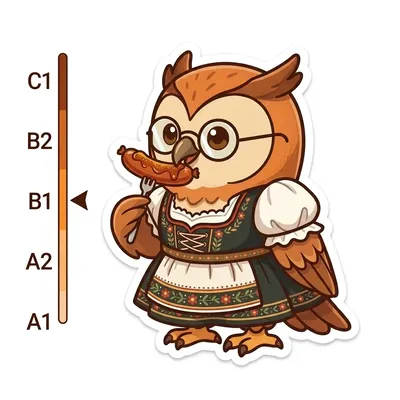
Is German Hard To Learn For English Speakers
It's a rather common misconception that German is a hard language to learn when you already know English. Here's why "hard" is relative.
Short answer: no. Not at all.
It's a rather common misconception that German is a hard language to learn when you already know English. Here's why "hard" is relative.
English and German share common roots. Many words and grammar patterns are overlapping. With a bit of training you'll be able to identify German words without having crammed their meanings into your memory yet e.g. with flashcards. Grammar wise the main difference is the articles and the cases. That's very uberschaubar (manageable) and with the right approach also YOU - my young padawan - will master the Macht.
Do I need to learn the German alphabet first?
You already know the alphabet which is why it makes zero sense to torture students with the bloody alphabet in German language classes. God man, that's awfully boring and yes, the pronunciation is of course different but you won't learn pronunciation by going through 30 individual letters in a list. Start reading because unless you are forced to spell your name 3x a week, it makes zero sense to start with the alphabet or to learn the pronunciation of more individual letters than your name and address contain.
How hard is German compared to other languages?
German is a category II out of IV (hardest) language according to the FSI (the Foreign Service Institute, US) which trains diplomats. Only languages like Spanish or Italian are easier than German but who likes it THAT easy, right?
Does teaching method matter?
It's a matter of how you are being taught. After 25 years of ongoing research I can safely say that the biggest issue with German is the way it's been taught world wide. Many teachers believe that one must teach German using only German. In my professional opinion after writing a master thesis on this matter, I can safely say that this is a very reputation damaging fallacy. See Butzkamm et al (bilingual-approach.com) for the science behind my claim which is also based on my practical experience.
What about learning German in a group?
Another factor that complicates things is the organisation of students in groups. Groups come with their own dynamics and have many downsides which in my professional experience and opinion outweigh their benefits, which are a highly structured and social framework.
When allowing the students to learn in their own pace and space with the right amount of guidance, the quality of the learning experience increases significantly in my experience. This doesn't mean that one can't learn German in a group or with German only instruction but those things simply make the learning experience a rather tough one and contribute to the perception that German is a difficult language to learn.
"Hard" also often simply means the student is trying to bite off too big a piece of the cake and then is surprised that she feels overwhelmed. The student is not to blame here. Only few of us have actually learned how to learn properly and a teacher that has to keep an eye on 20+ students all the time simply can't help all of them. Imagine you have to share a teacher with 20 others which would mean you get only 3 minutes of undivided attention per hour. That's not really a lot so basically you are studying on your own among other self learners with a supervisor for emergencies.
How long does it really take to learn German?
Things feel hard when one doesn't get them right or practices too little. In many German classes they follow a fixed curriculum and have rather little wiggle room to slow down and deepen a certain topic. You are expected to trot along with the speed of the class. Missed a day? Catch up on top of your class pensum. Miss three days, you are almost certain to massively fall behind.
If you can take all the time you need to digest things that are not easy to grasp especially not when explained in a foreign language - things change. You only move on when you got one thing right and have the mental space for something new.
It's also often overlooked that learning German actually takes 2-3 years until learners can express themselves with ease. That's a marathon and if you start one without knowing by when you'll cross the finish line you'll be suffering for most of the way after the honeymoon is over. Sure, they say you can get to B2 in 9 months (at 3hrs a day) but what they don't say is that barely more than 50% actually make it even past B1. 2-3 years for most learners if not longer. And that's not the problem but the expectation to be done after 9 months might lead to rushing and rushing leads to gaps and the feeling of not having fully grasped the language yet. You certainly understand that that is not a good feeling to have. That's also why many students often think they have to retake a level or half a level (however anyone calculates half a level).
Is German grammar hard?
The cases and their endings are basically a single table which takes you 1 hour to master over the course of a week if you take it easy. How to use them then is the job of your teacher to explain you step by step, one after the other until it clicks. You will always have to learn your genders/articles. THAT is the only thing that truly accompanies you until you have mastered the gender of 2000-3000 nouns. But that's also just a matter of time and the genders are among the easiest things to memorise with help of my superhero technique.
| Case | Masculine | Feminine | Neuter | Plural |
|---|---|---|---|---|
| Nominativ | der | die | das | die |
| Akkusativ | den | die | das | die |
| Dativ | dem | der | dem | den |
| Genitiv | des | der | des | der |
Keep in mind that I assume that you know English already. If you didn't know a language with Latin alphabet you will indeed struggle a lot more than any English speaker. But as you are reading these lines you are fine.
German is not necessarily a hard to learn language especially when one already speaks English. The main reason for this perception is in my professional experience and opinion very often simply bad teaching or learning strategies and wrong expectations. This is not to blame students nor teachers. I believed many things about teaching in my early years because I never questioned them. But after thorough research, the above is what I would put my hand into fire for.
Frequently Asked Questions
Is German the hardest language to learn?
Not even close. The FSI puts it in Category II - one step above the easiest group. Mandarin, Arabic, Japanese take more than twice as long. If you already speak English, German is one of the more accessible languages out there.
Can I learn German in 3 months?
You can get to A1 basics in 3 months if you study daily. But real conversational fluency? That's more like 1-2 years for most people. The 9-month promises sound great but barely half the students in intensive courses make it past B1.
Is German grammar harder than English grammar?
It's more visible - you actually see the cases, genders, and endings. English hides its complexity in a mountain of exceptions. The German case system fits into one table. You can learn it in a week. Using it naturally takes longer, obviously.